

Time
Where has yesterday gone?

🎥 Youtube’s Memory Lane
History sometimes yields unexpected surprises. There was a time when you could publish a video from your camera roll in just two clicks. Apple integrated so well with YouTube, that the streaming platform’s mobile uploads grew by over 15x in just six months.
The “IMG_0123” universe had begun.

During the Send to YouTube era of 2009 and 2012, the title of one’s YouTube video was defaulted to this naming convention [ IMG_0123 ]. Unwitting content creators would then upload their videos on a public site with a barely-searchable name. To this day, there are millions of these videos. (From: IMG_0416, Ben Wallace).
I dare you. Pick your favourite 4 digits number. Add “IMG_” before it. Search it on Youtube. Enjoy a random collection of raw moments from the camera roll of stranger’s over a decade ago. You won’t be missing your current feed.
The number I chose was 0226, so I searched for “IMG_0226” on YouTube. As I browsed, I experienced the distinct qualities of a bygone era of the web. It’s like a scavenger hunt down memory lane.
Contrast it with today's feeds. It will feel like you suddenly embarked on a trip to a remote island. No catchy intros, click-baiting subtitles, or exaggerated claims. Zero editing. Just moments someone decided to film for some or no particular reason.
The ecology of social media has evolved in front of our eyes. We didn’t notice. The apps stayed the same, their inner universes changed.
Go look for your IMG_0416 videos. They’ll be funny, intimate, cringe, or all of the above. They will feel like a distant reality.
For the pragmatic in heart, those videos might even offer a significant answer to the everlasting and excruciating question: where has yesterday gone?
⏳ Time is a shared creation
The idea that we all see the same universe and that each one of use has their private universe are equally preposterous!
The legacy of quantum physicist John Wheeler - widely known for his delayed-choice thought-experiments - was recently explored on the Quanta essay: John Wheeler Saw the Tear in Reality.
His last journal entries, before his death in 2008, open up fascinating questions.
Does hope produce space and time?
For Wheeler, it is by choosing what to measure in the present, that we participate in the creation of the past.
“It is not a paradox that we choose what shall have happened after it has already happened, ” he wrote, because “it has not really happened. It is not a phenomenon until it is an observed phenomenon.” If a tree falls in a forest and no one is around to hear it, has it made a sound?
The past is not really the past. Time is not really time. We weave the fabric of the universe, he said, out of “billions upon billions of acts of observer-participancy”.
If the past’s certainty eschews us, what could we expect from the future?
🏪 When do markets stop being a voting machine and turn into a weighting machine?
Some horizons of meaning are clearer, other are more clouded.
In August, investment strategist Joachim Klement made a plausible case that near-term and the long-term are far more manageable than the dreaded yearly forecast. He reasoned from accounting variables and fundamentals, but his message is clear.
Please, stop trying to forecast the next 12 months and focus either on the next three months or the next three years. But my guess is, I will still be asked about the next 12 months and will continue to write annual outlooks and the like because that is what most people want. (Substack)
Intuitively, there seem to be discontinuity across forecasting horizons. We need different gears for the short-term and long-term. The expectations shift: the market no longer acts like a voting machine (picture a herd emotionally-charged chasing momentum) and turns into a balanced, harmonised, weighting machine. It’s the kind uncertainties change.
Meanwhile in the deep and wild derivatives universe of Chicago’s CBOE Futures Exchange, there are now options on implied volatility (VIX) futures available for trade. If that sounds confusing, I won’t even begin explaining it. Traders that wish to speculate on the expectations of near-term volatility have a new tool in their toolbox.
Pricing it won’t be for the faint of heart. If one was just getting accustomed with the concept of Volatility of volatility, now it’ll need to meet vol. of vol. of vol. (!)
🧮 Two is easy, three is hard
Every mathematician knows that a drunk man will find his way home, but a drunk bird may get lost forever.
In other words, a random walk in two dimensions will eventually visit every point of the plane, while in 3D there’s no such guarantee.
This is an example of the mathematical meta-phenomenon “Two is easy, three is hard”: there are many classes of problems that are easy in two parameters and become computationally intractable when another parameter is added.
The very famous three-body problem of Newtonian mechanics is another case in point. When three bodies (say the Sun, Earth and the Moon) orbit each other, there is no general closed-form solution.
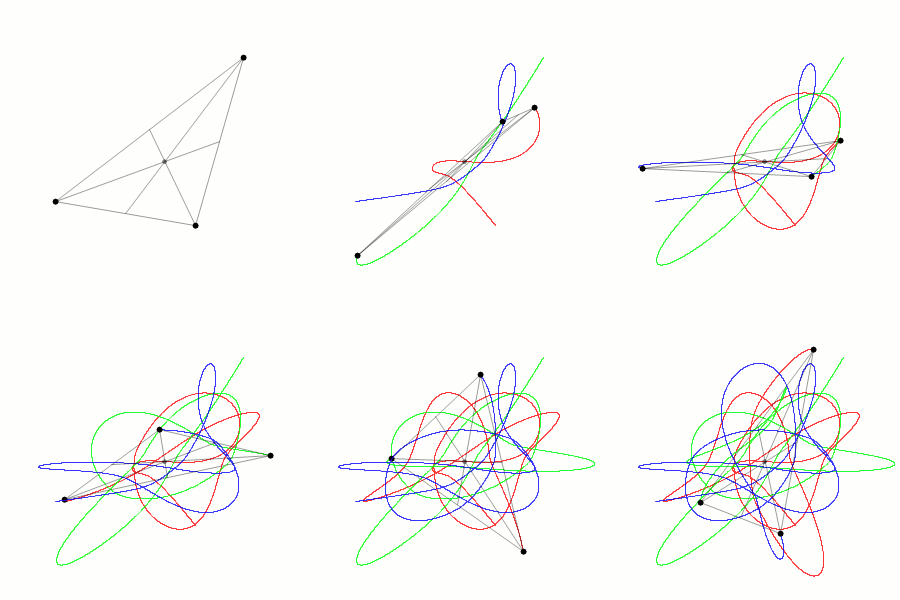
For a broader picture, this MathOverflow thread named “When is 2 qualitatively different from 3” explores a theme that should feel familiar to this readership. It’s what we (poetically) approached in our “Stories with n characters” series (spoiler: it’s far from over).


The MathOverflow thread offers a bird’s eye view into a lot of mathematics, from voting theory to statistics, with a lot of algebra and set-theory in between. The Tarski paradoxes (and implications of the Axioms of Choice) stood out to me. Dividing a set by three without the axiom is a trickier construction than it seems!
Another user points out a fact that’s worth keeping in mind:
Mutual information of two random variables is non-negative and I daresay well understood. Mutual information of three or more random variables can be negative, and is monstrously unintuitive.
In which other circumstances have you encountered this pattern?
David